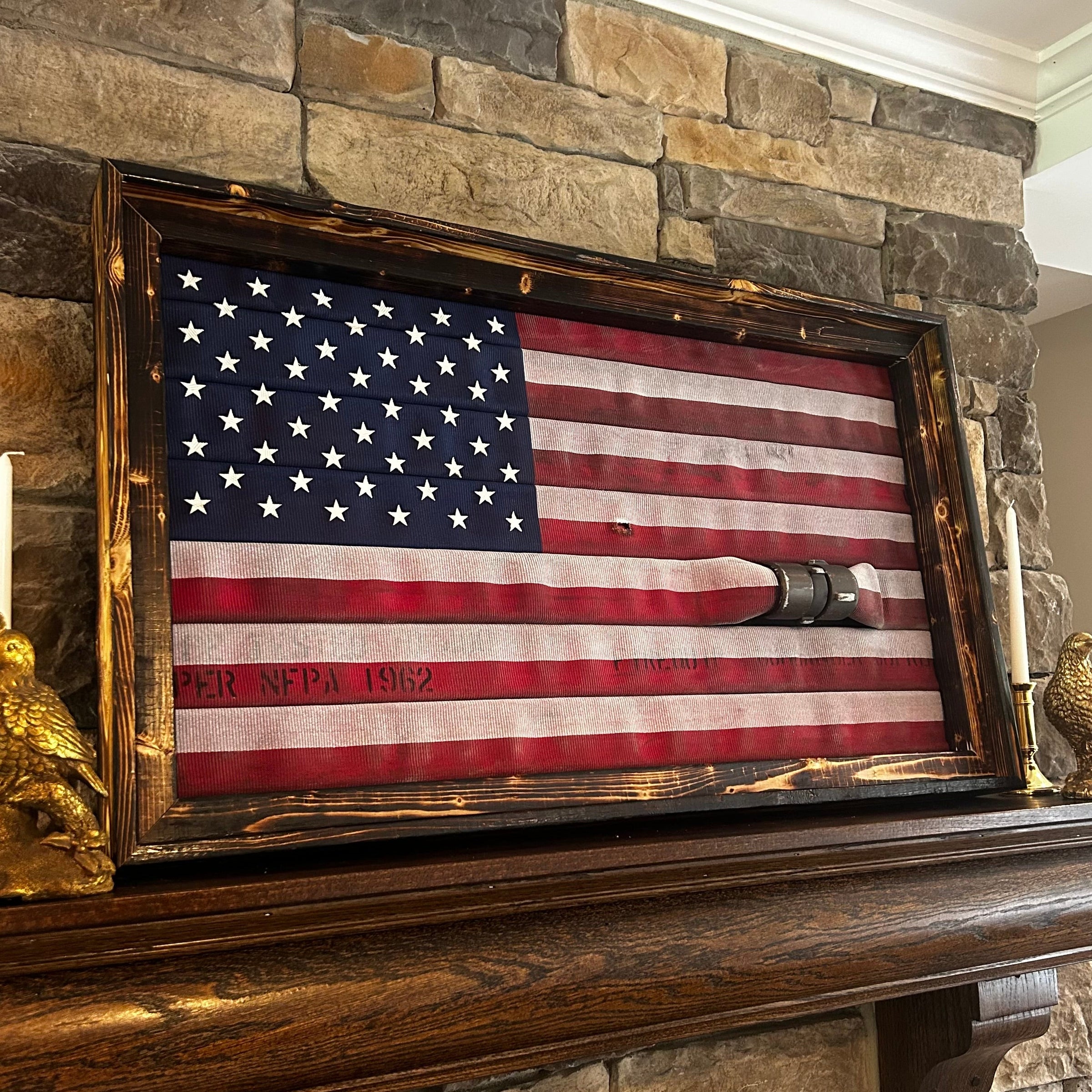
The Firehose Flags

Introducing

The Firehose Flags

Built from fire hose- engineered to hold water at pressure and to survive being dragged across gravel. It does not tear, fray or rot.

shop the flags

Two hoses. Four flags.

Every flag we build is one of two hoses, made into 4 styles. Pick the hose for the look you want, then pick the style.

The two hoses

Decommissioned hose

Decommissioned hose

Attack line that already served. It carries the scuffs, patina and scorches it earned, so no two are alike.

New hose

New hose

Unused stock off the same production line. Clean, bold colour, no marks — same material, different look.

The four styles

Coupling flag

Standard flag

Coin board

Pickhead flag

Full-bleed — two hands stretching a length of hose across the bench

New Hose Or Decommissioned

Built To Be Dragged.

The same hose that held water at pressure and came back off the truck scuffed. We cut it, wash it, and frame it.

what our customers are saying

Bought this as a gift for my brother who's a firefighter, and he loves it!!!
Alyssa March 20, 20265 out of 5 stars
So happy to have this in my collection — the craftsmanship and attention to detail is top notch.
Jeffrey October 8, 20255 out of 5 stars
Amazing product!! Very well done and high quality.
Jaron April 30, 20265 out of 5 stars
A flag should carry some evidence of the work behind it.

A flag should carry some evidence of the work behind it.

Hose asks something of whoever builds with it. It resists the blade and it holds its curl. In return it outlasts almost anything else you could hang on a wall: nylon that does not rot, a rubber liner that does not crack, and a weave rated for pressure rather than appearance.

We buy it both ways — new from the mill and decommissioned from departments pulling line out of service. Every length is pressure-washed before it reaches the bench.

shop the flags

Firehose Coin Board - Station 14 Flags

Featured

The Firehose Coin Board

The smallest thing the workshop makes. Two shelves cut from metal, framed in torched wood, sized to sit on a desk or hang beside a door.

Same hose, same frame stock and same hand-torched finish as the full flags.

$50.00

Shop Now

Guaranteed
We stand behind every flag against defects in material and workmanship.
Material
Woven nylon fire hose, solid wood, American hardware. Nothing imitation.
Mounting
A cleat ships installed on every piece, rated to ninety pounds.
Shipping
Free shipping on every order, one to two weeks from the bench.

Flag Questions, Answered

A flag should not need an instruction manual. Choosing one, and hanging it properly, raises fair questions.

Which flag should I start with?

The full sized flags (24" x 43") are the pieces most people hang first — large enough to hold a wall on its own, small enough to fit above a mantel or a desk. If the piece is going somewhere it will be looked at closely, take the Coupling Flag; the fitting is what tells a visitor what the material is.

What exactly is fire hose made of?

A woven nylon jacket over a rubber liner, built to carry water at pressure and to be dragged across gravel and glass. It does not tear, fray or rot. We build from both new stock, bought new, and decommissioned line retired out of service — the product page says which.

Why is the frame burned?

Softer early growth in the wood chars first and chars darker, so a flame separates the grain into light and dark without any stain. After the burn the board is brushed back and sealed in polyurethane. A pale frame argues with the hose; a dark one lets it sit.

How do I hang it?

Every flag ships with a cleat already installed and rated to ninety pounds. Find a stud, set the wall half of the cleat level, and drop the flag onto it. At the large size the cleat is not a convenience — it is the only correct way to hang the piece.

Step-by-step installation instructions, with drawings →

Will it fade or need maintenance?

Nylon hose is rated for abrasion and UV, so it holds colour far better than canvas or cotton would. Decommissioned line has already done most of the fading it will ever do. Dust it with a dry brush. Do not wash it and do not oil the frame.

Is my flag made from new or decommissioned hose?

Whichever the product name says. Decommissioned pieces use line retired out of service and carry its marks; new-hose pieces use fresh stock with a clean weave. Both are the same nylon construction and the same build. We cannot trace decommissioned hose back to a particular station — it arrives in mixed lots.

How long does an order take?

One to two weeks. Each flag is cut, painted and burned to order in Lancaster, South Carolina, then packed by the people who built it. Shipping is free on every order.

Read The Stencil

Still In Service

Know Your Flag

Read The Stencil

Most decommissioned hose still carries its markings: a manufacturer, a diameter, a service-test date, sometimes a department name stencilled along the jacket. We cut around them where we can. If a stripe on your flag has a number running through it, that is not a defect — it is the last thing the hose was asked to prove.

See the flags

Flag Notes // The Handbook

Shou Sugi Ban

Shou Sugi Ban

Japanese builders worked out by the fourteenth century that a charred board outlasts a bare one: the burn closes the surface against water, insects and rot, and the technique was used on cedar cladding for centuries before anyone called it a finish. We torch solid wood for the same two reasons — it lasts, and the grain tells you what it is.

The Fire Hose

The Fire Hose

Jan van der Heiden sewed the first practical hose in Amsterdam in 1673: leather, stitched, fifty feet at a time. Rubber-lined linen followed in the 1800s, then woven cotton jackets, then the synthetics in service today. Every change answered a fire that had gone badly. The line we cut is the end of that argument.

Thirteen Stripes

Thirteen Stripes

The Flag Act of 1777 runs thirty-one words and specifies almost nothing: thirteen stripes, red and white, and a union of thirteen stars on blue. Proportion, star arrangement and shade were left open for 135 years. Which is why early American flags were made by hand, by people who decided the details themselves.

What Decommissioned Hose Actually Is

What Decommissioned Hose Actually Is

A woven nylon jacket over a rubber liner, built to hold water at pressure and to be dragged over gravel and glass. The jacket is the part you see, and it is close to untearable.

The Ninety-Pound Cleat

The Ninety-Pound Cleat

A French cleat carries weight into the wall rather than out of it. Every flag ships with one installed, which is why a twenty-pound piece needs no anchors.

How to install it
Leaving Service

Leaving Service

Every length of hose in an American department is service-tested each year at pressure. A line that fails comes off the engine permanently, and most of it is destroyed. We buy it instead, wash it, and put it back to work on a wall.

Built for pressure. Hung for good.